When Salone was a showcase and what has changed
For many years, the Salone del Mobile followed a very precise logic. It was the place for presentations: new products, new collections, and new design languages.
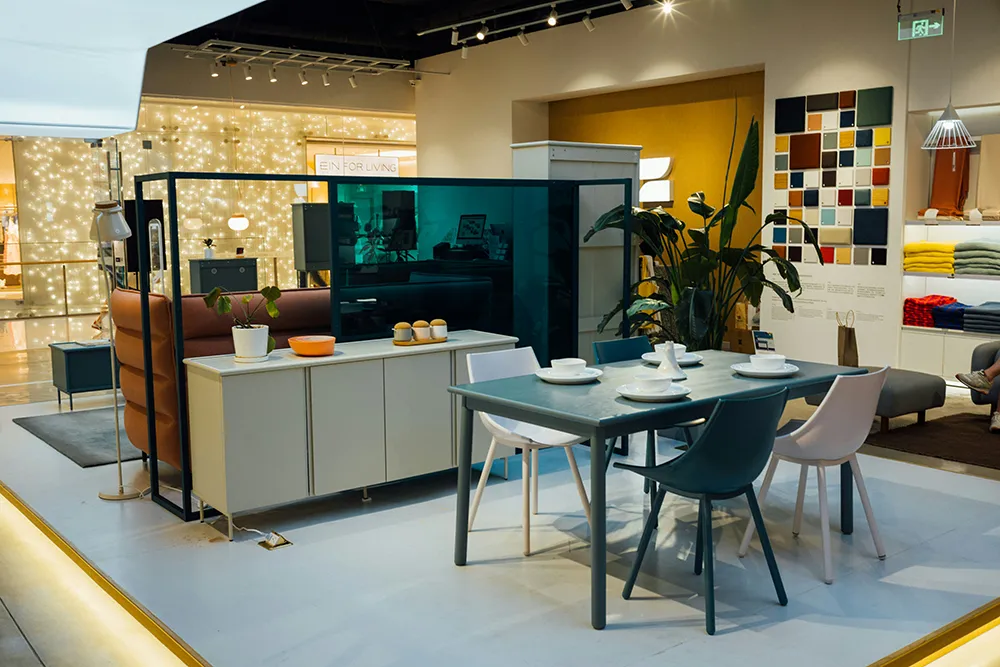
The layout of the stands themselves was conceived to display objects in an orderly, legible way, almost like a catalogue.
The arrangement was designed to guide visitors, who would observe and select.
This approach still exists today, but it is no longer enough to fully describe what is happening.
Over time, more and more companies have shifted their focus from simply presenting objects to building contexts. Stands have become actual environments, where collections feel less rigid and less strictly defined.
In this new scenario, the product alone is no longer enough to convey the concept. It needs to be seen within a specific context: it must interact with the space, the light, and all the surrounding elements.
This marks an important shift: projects are no longer read through individual objects, but through systems and contexts.
The growing role of Fuorisalone
At the same time, Fuorisalone has also undergone significant changes, gaining increasing importance during Design Week.
Initially conceived as an extension of the Salone del Mobile, today it has become the most interesting part of the entire Design Week.
The difference between the two lies in their language: Salone maintains a more exhibition-oriented structure, even as it evolves. Fuorisalone, on the other hand, moves with greater freedom.
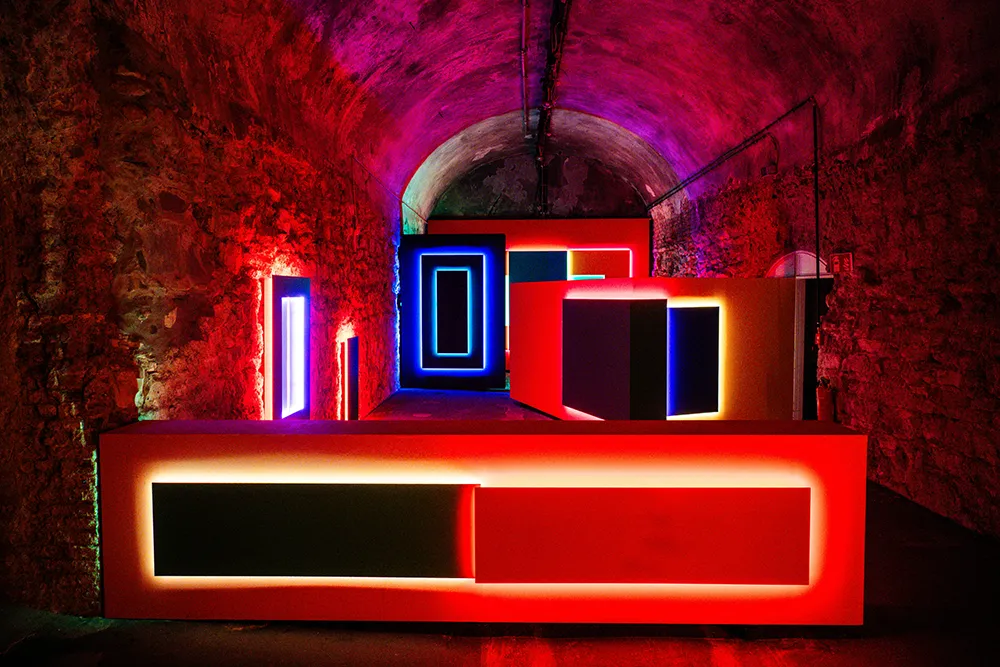
Fuorisalone installations do not necessarily follow a commercial logic. They are not required to explain a product directly; they can be more open, conceptual, and interpretative.
It is quite common to enter a space without finding clearly identifiable objects yet still perceive a very precise idea.
Light, materials, sound, and spatial rhythm all contribute to building a true experience.
The visitor is no longer just observing, but moving through and perceiving and it is precisely within this new dimension that many of the most interesting directions in contemporary design emerge.
The return of materiality
Another aspect that has become more defined in recent years is the return to materiality.
After a long period dominated by highly uniform and controlled surfaces, there has been a gradual shift back toward more authentic materials.
Wood with visible grain, raw stone, less processed metals, and surfaces that embrace imperfections and variations.
This choice reflects a different way of constructing space, one that is more connected to overall perception rather than image.
This return to materiality also directly influences another key element: light.
The use of these materials requires a non-neutral lighting approach, one capable of enhancing surfaces, restoring depth, and creating hierarchy.
It requires precise, calibrated, and conscious balance. Light that is too uniform risks flattening the environment; light that is too aggressive distorts it.
In this context, it becomes clear that light is no longer just a technical element, but an integral part of spatial composition.
More fluid spaces, less defined objects
Another subtle but significant change can be found in the understanding of space, which is gradually losing its rigid divisions.
On one hand, objects are losing their precise classification, positioning themselves somewhere between furniture and architectural elements. On the other hand, spaces themselves are becoming more fluid, continuous, and less tied to a single function.
This fluidity reflects a different design approach - less schematic and more focused on relationships between elements.
A polarizing market
A significant shift has also taken place in market dynamics.
In recent years, we have seen the rise of increasingly accessible products designed for a broad audience, alongside a growing interest in craftsmanship, unique pieces, and limited editions.
These two directions do not exclude each other: they coexist, showing how design operates on multiple levels, with different languages and objectives.
What to expect in 2026
In light of these changes, the 2026 edition of Salone del Mobile and Fuorisalone will not represent a sudden break.
Rather, it will make even more evident some of the directions already underway.
Increasing integration
Design will continue to be approached in a less fragmented way, with architecture, furniture, and lighting working as a unified system.
The focus will be on creating coherent environments from the outset, rather than inserting elements into a space.
Experience as a central role
Fuorisalone will continue to push toward a more experiential dimension.
Installations will become increasingly immersive, designed to be lived rather than simply observed.
Design will be perceived through movement, time, and interaction with space.
Material and perception at the core
Materiality will remain central.
Surfaces, textures, and continuity will continue to guide design, requiring an increasingly precise and thoughtful approach to lighting.
Growing hybridization
Objects will continue to lose their rigid classification.
Categories will overlap, making room for more flexible and adaptable solutions.
A more distinct market split
The polarization observed in recent years will become even more evident.
Alongside accessible products, the segment tied to craftsmanship, the value of the object, and the “one-of-a-kind” piece will grow even stronger.
Beyond the event
Looking at the Salone del Mobile and Fuorisalone today means observing a direction.
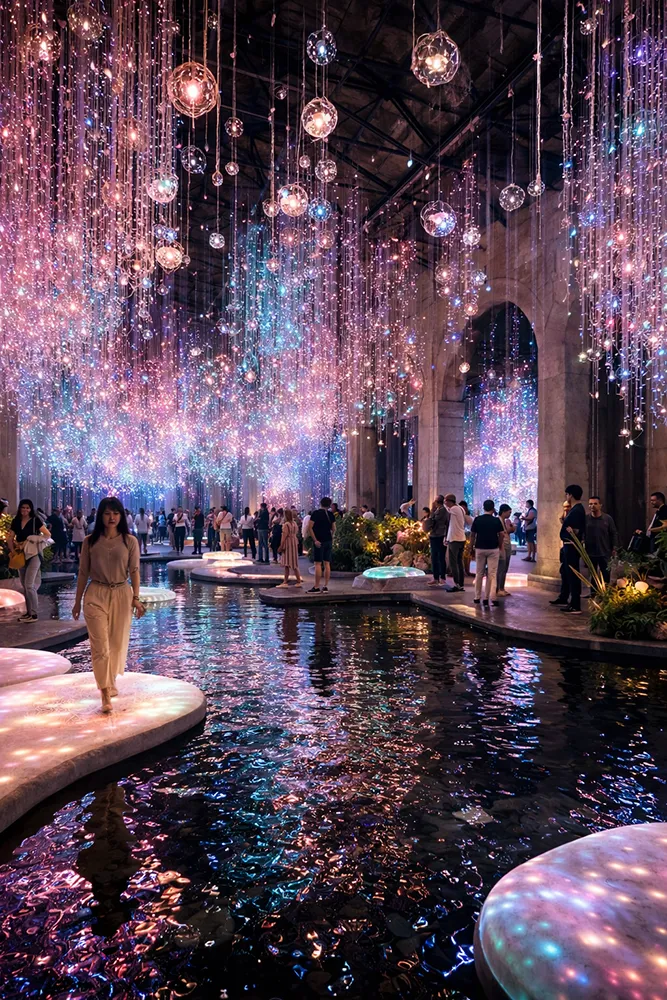
They are no longer just places to identify products or solutions, but real tools for understanding how design itself is changing.
A shift that primarily concerns how the different components of space relate to one another no longer as independent elements, but as parts of a unified whole.