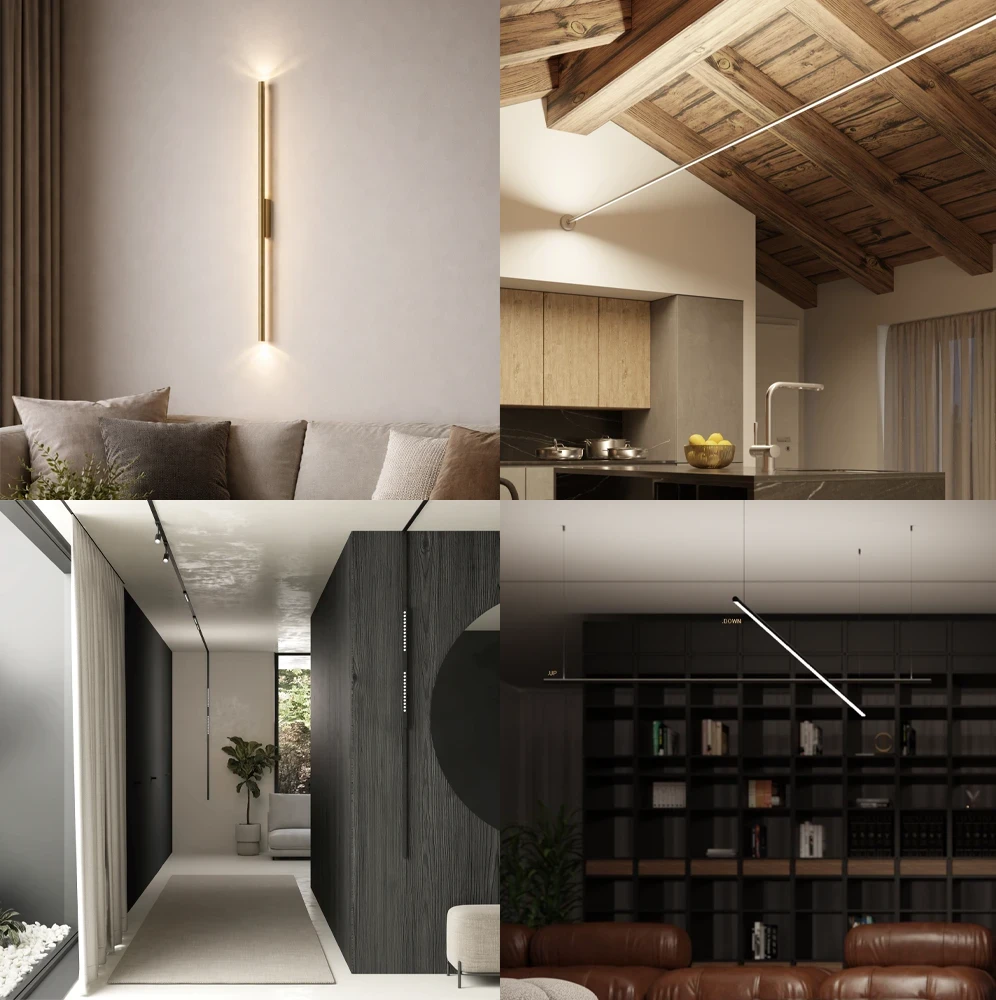
Surface-mounted LED profiles: linear light on the ceiling, without recessing
Surface-mounted LED profiles are one of the most versatile solutions for lighting a space without a false ceiling. They can be installed directly on the ceiling or on the walls, creating continuous, minimal lines of light that are consistent with the architecture.
LuceControCorrente offers several types of profiles. The slimmer versions can blend in discreetly, almost simulating the effect of a recessed line; larger profiles, on the other hand, have a bolder presence and become an integral part of the room’s design.
As manufacturers, we can also work on dimensions, machining and finishes, creating special colors or details to harmonize the profile with the materials and the language of the project.
These systems are particularly suitable for living rooms, kitchens, corridors and open-plan spaces. They can follow the geometry of the space, create linear or geometric compositions and visually connect different areas of the home.
Before installation, it is necessary to define:
- the position of the power supply point;
- the route and dimensions of the profile;
- the location and accessibility of the driver;
- the length of the light runs;
- the power and color temperature;
- the type of light emission;
- the switching and dimming methods.
The result also depends on the quality of the LED source and the choice of diffuser. A correctly sized system provides even light, minimizes the visibility of individual LED dots and ensures better visual comfort.
Electrified tracks: ceiling spotlights without a false ceiling
Electrified ceiling tracks are an effective solution when you want spotlights without plasterboard and without recessed installation work. The track is surface-mounted and can hold adjustable projectors, linear elements or compatible pendant fixtures.
The main advantage is flexibility. Light fittings can be positioned according to the furniture and aimed at tables, work surfaces, walls, artworks or architectural details. If the layout of the rooms changes, the system can be reconfigured more easily than a series of fixed light points.
The track is particularly suitable for kitchens, living rooms, corridors, studies and spaces with several functions. It can become a deliberately visible graphic feature or be chosen in a finish close to that of the ceiling, so that it is more discreet.
To prepare it correctly, you need to define the power supply point and the route of the system, checking compatibility between track, fixtures, controls and accessories. It is also important to plan carefully the number of projectors, the optics and their aiming, avoiding a random distribution of spotlights and limiting any glare.
Suspended cable systems: bringing light where it is needed
Suspended cable systems, made with cables or lightweight suspended structures, make it possible to bring light even far from the existing power supply point. They are particularly useful in large rooms, for lighting high ceilings without a false ceiling, or where architectural constraints make building a false ceiling impossible or inadvisable.
A suspended cable system should not be seen only as a technical solution. Its visual presence can become a genuine design element, able to cross and define the space. Depending on the model, it is possible to combine general and accent lighting, differentiate the switching and adjust the light intensity to create different atmospheres in the same area.
From a technical point of view, especially for systems of a certain size, the design must carefully consider the position of the anchors, the length and tension of the spans, the type of power supply and the characteristics of the supporting surfaces. Walls and ceilings must be checked in advance, so as to ensure fixing points that are suitable and structurally reliable.
Proper design therefore makes it possible to combine safety, light quality and aesthetic consistency, turning the suspended system into a presence that is integrated into the architecture.
Wall lights: using the walls to light the room
When it is not possible or not desirable to work on the ceiling, wall lights make it possible to use the walls to obtain direct, indirect or diffused light. They suit corridors, bedrooms, stairs, entrances and living areas, but can also contribute to general lighting if chosen and positioned correctly.
Models with upward emission enhance the ceiling and produce a soft, diffused light. Those with double emission draw the wall, while adjustable versions can be used for reading or to light specific elements.
Modular wall lights also make it possible to place several elements side by side to create genuine patterns of light on the wall. The arrangement of the fixtures and the play of light and shadow turn the surface into a true “work of light”, with compositions customized to the space and the desired effect. A particularly interesting solution for enhancing large walls, stairwells or double-height rooms, where lighting becomes an integral part of the decorative scheme.
Thanks to in-house production, LuceControCorrente has also developed wall lights with articulated arms or dedicated adjustable sources. These solutions are particularly useful in rooms where the walls must perform several functions: providing general lighting and, at the same time, creating an accent on an artwork, a painting, a piece of furniture or an architectural detail.
Here too, preparation is essential. Electrical points must be placed at the correct heights, considering the position of the furniture, the direction of the light, the desired effect and the size of the fixture. An electrical box placed without knowing the product can limit the choice of wall light or compromise the balance of the composition.
How to choose the right solution to light ceilings without a false ceiling
There is no universally best solution: every room requires a specific assessment. To identify the most suitable system, we start from the analysis of the floor plans, renderings and available project information. When necessary, a site visit lets us better understand proportions, materials, technical constraints, power supply points and relationships between spaces.
This first study is essential to understand how to enhance the architecture and to advise the client on a solution that fits their functional, aesthetic and budget needs. Often the most effective result comes from combining several systems:
- surface-mounted profiles provide linear, even and integrated light;
- tracks make it possible to aim the light and change the configuration over time;
- suspended cable systems make it possible to span distances and overcome architectural constraints;
- wall lights add indirect light, depth and accent points.
The choice should also start from the activities carried out in the different rooms. In the kitchen it is important to light the worktops properly; in the living room, general light, accent points and decorative sources can coexist; in the bedroom, comfortable light is preferable, alongside fixtures dedicated to reading; in corridors, evenness and orientation must be ensured.
Color temperature, color rendering, optics, light intensity and control systems must be defined together. An efficient fixture, in fact, is not enough if it is placed in the wrong position or does not meet the real needs of the space.
Preparations to plan before the works
In a home without a false ceiling, the position of the power supplies is even more important, because cables, connections, drivers and fixings cannot be hidden as easily as with a recessed system.
Before the works begin, it is therefore advisable to define:
- the position of the furniture and the functions of the different areas;
- the power supply points on the ceiling and walls;
- the routes of linear systems;
- the space needed for drivers and technical components;
- the division of the switching circuits;
- any dimming;
- the load capacity and type of supports;
- accessibility for maintenance over time.
Careful planning avoids trunking added later, unplanned visible connections and corrective work. When existing light points cannot be moved, the project can integrate them into the new system or turn them into starting points for a surface-mounted composition.
A project driven by the space, not by the catalog
Lighting a home without a false ceiling means treating the technical elements as part of the architectural language. Profiles, tracks, cable systems and wall lights remain visible: proportions, finishes, routes and fixing points must therefore work with ceilings, walls, materials and furnishings.
LuceControCorrente develops lighting solutions for interiors and exteriors, starting from an analysis of the architectural and functional context. Our method includes the initial analysis, concept development, detailed design and production, with the option of making custom elements when the space cannot be solved with standard products.
The goal is not simply to choose a light fitting, but to build a system that is coherent, precise and genuinely achievable, in which light helps define the space. In-house production and design flexibility allow us to calibrate each solution to the characteristics of the space, to aesthetic and functional needs and to the available budget.
Want to light your ceilings without a false ceiling?
Every exposed ceiling needs a specific solution: profiles, tracks, cable systems or wall lights, alone or combined, depending on the space, the functions and the budget.
Fill in the configurator and tell us about your project: after analyzing the information we receive, within 72 hours we will send you a first lighting proposal to start developing the solution.